
Search sources
A boy's memories of VE Day
Durham u3a member James reminisces on his experience of VE Day, when he was a 12 year old boy living in Barnet.
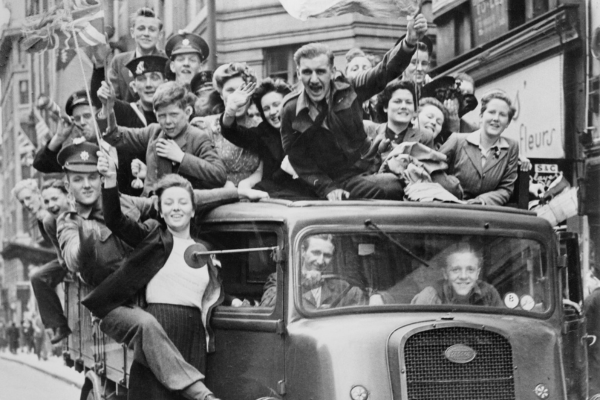
People celebrating VE Day in London in 1945. By an unknown photographer, this photograph HU 41808 comes from the collections of the Imperial War Museums.
My memory of VE Day in 1945, as a 12 year-old living in the North London suburb of Barnet, is of an overwhelming explosion of lights and noise.
For the past five years, Britain had been covered by a pall of darkness. True, lights were on in homes, offices and factories, but not one flicker, twinkle, or glimmer of light was allowed to escape into the night and into the vision of the German bombers circling overhead. This rule was rigorously enforced by battalions of Air Raid Wardens prowling the streets and bellowing to every house who’d dared to wink at them.
On the streets themselves, all street lights had been extinguished, their role having become largely superfluous as all the street signs had been removed to confuse German parachutists and British citizens alike. Pedestrians could be seen with torches pointing dimly to the ground in front of them. Dare to let the beam temporarily rise to horizontal or – an imprisonable offence – vertically towards the heavens and the circling Nazi planes, and the police would readily provide a roof over your head. These pedestrians would be occasionally pursued by slow-moving cars, with headlights dipped and dimmed behind slats to further minimise their already faint beams. Sound wasn’t actually banned; but what was there to make a noise about? News, not music, was the staple diet of radios in those dark days.
Daily life was as dark as the environment. We were constantly at the mercy of bombs, doodle bugs, and the terror of V1 rocket which, unlike those other weapons, would kill you before you knew it, their arrival being quicker than the roaring noise they generated.
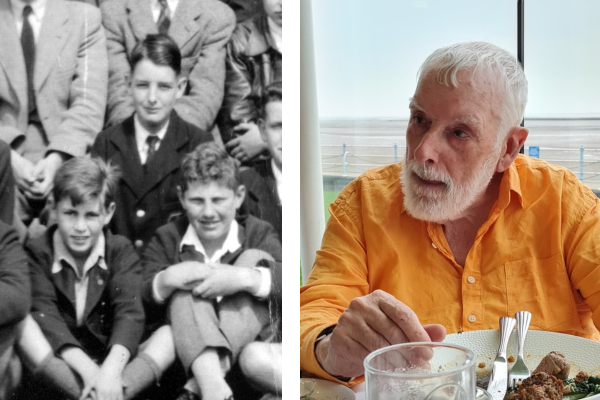
Left: Alan, aged 12, a couple of months after VE Day (in the centre)
Right: James, aged 90
Come VE Day, all this darkness was swept away. It was as though Winston Churchill, after announcing the surrender of Germany, had thrown a huge lever in Downing Street, upon which the whole nation underwent a pantomime transformation scene.
Suddenly, there were lights everywhere! Every room in every house in every street in every village and town in the country, it seemed, switched on all the lights they possessed, in a surge of joyous celebration that must have given heart attacks to the country’s power generators. Theatres and cinemas switched on all their fairy lights, pubs hastily placed tables and chairs outside on the pavements and pretended to be bistros, ships at sea and on our rivers festooned their superstructures with lights. Meanwhile street lights beamed at passersby who carefully avoided being squashed by cars with headlights blazing forth like lighthouse beacons, all against a background sky on which searchlight beams danced around each other like laser lightshows.
And with the lights, came sounds. Radios, record players and radiograms were turned up to their highest volume. Windows and doors flung open so the sounds could swamp the streets. Impromptu bands of musicians paraded up and down. Everyone owning an instrument brought it out and hammered away at it, while the lit-up ships blared their sirens. Dogs barked furiously as they chased each other, while boys chased girls across the rubble of bombed-out houses without knowing why, but it was all great fun.
Grown-ups, including my mother and 17 year-old sister, travelled on the Tube up to central London to join the thousands upon thousands surging towards Admiralty Arch and the Mall. There was only one place that night where everyone wanted to be: outside Buckingham Palace. Excitement electrified the atmosphere. Flags were waved as ten thousand Vera Lynns opened their throats, promising that bluebirds would forever be meeting again over the White Cliffs in an England that would always be kept warm by all.
Teenage girls and bold young women excitedly rushed around kissing every serviceman they could find to embrace, who couldn’t believe their luck. Other soldiers had climbed up the telegraph poles and street lights, all the better to see what was going on. Somewhere in the crowd, it was rumoured, were the two Princesses, Elizabeth and Margaret, lending their voices to the vast roars of: “We want the King! We want the King!”.
And there, on the famous Balcony of Buckingham Palace, at last appeared the King, the Queen, the Royal Family, and Winston Churchill, cigar jutting out like a battleship’s gun. Cheer after cheer roared out from the crowd until, eventually, with regal waves, the Royal party went back inside, and the principal act in the drama entitled VE Day was over.
Back home in Barnet, those of us not allowed or unable to make it ‘up the Smoke’ had our own celebrations. Our local pork butcher, Eli Frusher, threw the grandest party for all and sundry that we’d ever experienced. Lights blazed away inside the shop, outside it, and half-way down the street. Music streamed from an overhead loudspeaker, bevies of girls danced together, and balloons bobbed around us while we ate our fill of sausages in buns, pork pies, sticky iced buns, and chocolate cake all washed down with ginger beer.
At last, stuffed to the gills, my gang and I drifted down to my house, opposite which was a narrow lane opening out into allotments. There, as the sky grew as dark as our old blackout curtains, we built the largest bonfire we’d ever made, on top of which we strapped Herr Hitler, complete with moustache and hairstyle, fashioned secretly out of my sister’s pyjamas. Then we lit it. Not with matches. Oh no. Somehow we realised this was the end of a world we’d had to grow used to for five long years. To celebrate the dawn of a new future we all stood in silence around our bonfire. It was lit, not with old-fashioned matches, but with a carefully poured out mixture of permanganate of potassium and sundry secret chemicals, and watched while this gloopy soup slowly turned into flames. These cast a rosy-red glow on faces quietly reflecting upon the past, the present, and what Mum would be giving us for our breakfast.
Next day the nation awoke, to find the celebrations of the day before were now just a hazy memory. The party was over.
But what a Helluva party it had been!
Previous & Next Articles in this category