
Search sources
Ageing without Children
Shepway u3a member Penny talks about the reality of growing older without the support of adult children - something that inspired her to get involved with the charity Ageing Without Children. She is now using her voice to campaign for changes in the health and social care system.
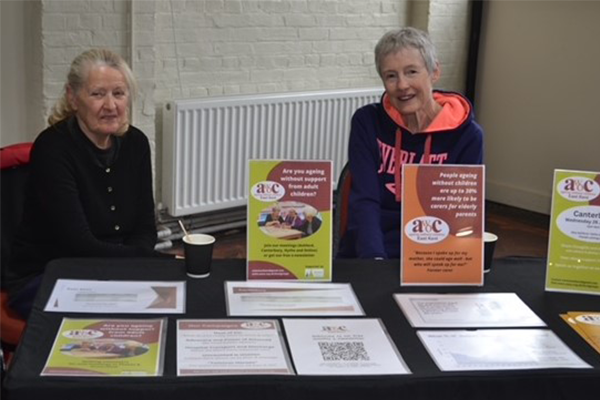
Penny and another volunteer publicising AWOC East Kent at a Carers Fair in June 2024.
I cared for my mother during the last ten years of her life. She had good friends but outlived them all so that in her final years I was her only source of support.
Being a carer made me realise how the health and social care system assumes that everyone has a family member or close friend to advocate for and represent them, manage their life admin and join up a chaotic variety of health and social care services.
As a Guardian article highlighted in August 2024, woe betide you if you become frail, have mobility problems or show early signs of dementia and have to navigate the health and care system alone.
But that will be my situation – I am an “AWOC”, someone who is ageing without the support of adult children. In my case, this is because I never had children, but others have children who are unavailable to provide support for reasons like estrangement, distance, death or the child’s own physical or mental health needs. Like many of us, I worry about how I will cope.
The number of people like me will grow dramatically in the next few years. Some of us will have same generation support but ultimately partners, siblings and friends age and, as you will know if you have been a carer for your parents, that is when the next generation steps in. We also live in “beanpole families” where there are more generations alive but less children in each generation meaning that we are less likely to have nieces and nephews or lots of cousins.
Many of us realise that the number of older people in the UK is due to increase significantly, but what is less well publicised is that a significantly larger proportion than now will be without next generation support.
The Office for National Statistics reports that the number of childless older women will increase dramatically over the coming years. Women born in 1946 (who are in their late 70s now) had a 9% chance of never having children. This more than doubled over the following twenty years with women born in 1966 (currently in their late 50s) having a 20% chance (ie. 1 in 5). The proportion of women who never gave birth then remained in the high teens over most of the following decade.
There is a real shortage of data beyond this. There is no equivalent data for childless men, and no data on how many who had children are estranged or live at a distance from them and no easily accessible data about those whose children have died or have additional needs. Anecdotally, we know that the significant numbers of older divorced dads is a relatively new social phenomenon, and that more children live overseas. But they are not counted.
There is also no evidence about where we live, ie. whether we are distributed across the country in the same proportions as other older people or concentrated in hotspots.
I have become a campaigner to get the health and social care system to recognise the need to behave differently and so enable people without family support to age well. I have helped to start AWOC East Kent, a local group within the network run by the national charity Ageing Without Children. We hold meetings where no-one “bangs on about their grandchildren”, research the additional information that we need to age well, and seek to influence health and social care locally.
I have found so many other AWOCs within u3a both locally and nationally. Shepway, my local u3a, has been very helpful in helping to publicise our local AWOC group and many of our members first heard about us that way. And a recent online presentation from the u3a Future Lives group on advance care planning resulted in so many questions about what to do if you don’t have “someone you trust” to act as your attorney or manage your affairs that I volunteered to deliver a presentation specifically on that – the slides are now available on the u3a Future Lives section of the u3a website. This presentation has since been repeated for Ageing Without Children nationally and is available on YouTube.
For more information on Ageing Without Children, visit their website. They run a private Facebook group for those ageing without children as well as a small network of local groups. Penny would be interested in talking with other u3a members about how their local u3a could provide learning opportunities and peer support for members who are AWOC - to contact Penny, email
Find out more about how u3a and its members are using its voice on the u3a Impact page.
Previous & Next Articles in this category