
Search sources
Solving family history puzzles with facial recognition techniques
Chalfonts u3a member Denise developed facial recognition techniques in her career as a Chief Immigration Officer. Now, they have proved helpful in her research into her family history.

I enjoyed a four-decade career with the UK Immigration Service, much of it spent serving overseas on diplomatic attachments. Spending time in such diverse locations as India, Pakistan, the Far East, three corners of Africa and all over Europe, as enjoyable as it was, also led to some unexpected experiences such as being tear-gassed, mortar-bombed, held at gun point, briefly taken hostage and twice arrested.
As a Chief Immigration Officer based in UK embassies, I delivered training to overseas-based airline check-in agents who embark travellers to the UK. This included utilising skills including identity document forgery detection and facial recognition techniques. This was intended to help them identify any passengers who presented falsified documents or who attempted to travel using genuine documents stolen from legitimate travellers. Facial recognition techniques in particular helped thwart many impostors, much to the annoyance of foreign criminal gangs involved in the lucrative trade of people smuggling and trafficking.
Nowadays, as a published author of crime fiction and true crime and a keen u3a member, I find life much less dangerous. Once I retired, I didn’t think any of these skills would be needed. However, in one session of my u3a family history group, members produced old photographs that they had inherited. They were struggling to identify the subjects due to an absence of anything written on the back of the photos. I realised my knowledge of facial recognition might prove useful to the group members.
This led to me giving a PowerPoint presentation to the group about how certain facial features are passed down the family line and are often shared by close family members. Using biometrics – the measurement of facial characteristics – and assessing the positioning of facial features in relation to each other, can assist us in confirming whether the subjects of those inherited photos are related to us. Biometrics can also enable us to match up elderly relatives we have known with photographs of them taken in their early youth.
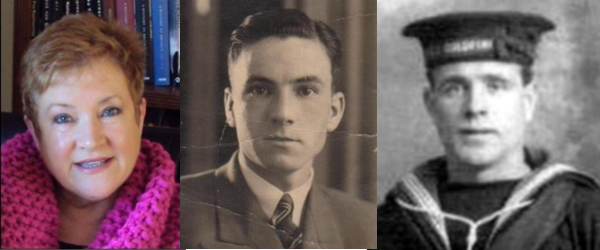
In the presentation I encouraged members to view images and to compare facial shapes, the size, shape and position of ears in relation to the eyes and mouth, lip and chin length, and numerous other features. Through doing this myself, I spotted an anomaly shared between me, my late father and my paternal grandfather. When trying on my first pair of prescription spectacles I realised that my left ear is slightly lower than my right, meaning spectacles just won’t sit level. If you look at the photographs below (left to right: me, my father, my grandfather), an imaginary line drawn across between the tops of the ears of the subjects in these photos clearly reveals this shared anomaly.
The presentation went down well and I’ve since given it to other u3a family history groups, both online and in person. One thing I have observed during my ten years in u3a is the remarkable collection of skills, knowledge and abilities our members have between them – it’s been great to share my own skills in an unexpected way.
Previous & Next Articles in this category