
Search sources
Learn new things with u3a
Members meet together at local u3as to continue their interests and learn new skills - all in informal and friendly settings where learning isn't about tests or grades, but about fun. In this article, u3a members share the things they've learnt through their u3a interest groups - from local history to how to cook with tofu.

York u3a Fairytales and Folklore group
Group leader Graham shares how his interest in fairy tales first started and some of the recent stories that the group have explored together.
The topic of folk and fairy tales had intrigued me, without much follow-up at the time, when, as a kind of party piece, I had read bits of two folktales. Both sections were from 'Cinderella:' one from Suffolk, the other Egyptian. With sharp cultural differences, their storylines are practically identical; I dodged between them while reading, without losing coherence, and I now know that there are over 500 Cinderellas in Europe.
The York folk and fairy tale group has 15 members, and meets once a month. We have a core book each year, but range widely beyond it, with themes suggested by the members and by me.
Our meeting this last Monday featured the Jack Tales; we think only of J and the Beanstalk, or the Giant killer. BUT there are hundreds more. We looked at The Scottish Traveller Tales of Duncan Williamson (the Devil's Purse collection and A Thorn in the King's Foot). I'm seriously impressed by his Death in a Nut, a secular parable featuring Death coming for Jack's old mother. I told it to my daughter when her granny died. There are Jack tales in the USA too, carried over with the highland clearances by Scots; they changed and adjusted in the Appalachian mountains, and Maryland, among others. Cecil Sharp collected Scottish Ballads in the Appalachians, but missed the stories, because he didn't listen for them.
Towards the end of last season we looked at the folktales about Oliver Cromwell that were, and still are, told in East Anglia (his home), Scotland, and in Ireland where he is a bogey figure following his cruelly efficient suppression of the Catholics. There is a whole archive in the Irish Republic of folktales collected from families and friends by Irish primary school children in the late 1930s; they include a Cromwell legend deeply embedded in memory and myth.
We did a session on Devils too, including a Yorkshire tale of an encounter with the Devil by a shoemaker on his way to repair the sandals of the Monks in Fountains Abbey.
I suppose that what we are learning is that stories travel, and change as they do so, adapting to each new setting where they are told. We looked again at the Suffolk and the Egyptian versions of Cinderella recently too - essentially the same storyline but with such intriguingly different settings and cultures - rural suffolk before tractors, and Egyptian viziers and palaces.
Guernsey u3a's Felting and Fibrecraft Group
Karen talks about sharing her passion for felting in a group with Guernsey u3a.
Our group aims to use felting as part of the process of making something useful. We use both Wet Felting and Needlefelting techniques.
I am an obsessed felter and so started the group to pass my love of felting onto others. We are a small group between six to nine people in each session which allows one-to-one help and a great team effort in encouraging each other.
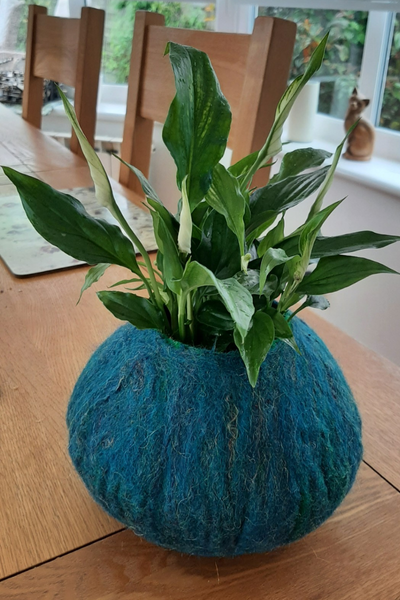
One of the things we have done in the summer of this year just before our summer break, was making a wet felted bowl. This involved lots of soap and water, lots of laughs, and some vibrant end results. we have recently commenced in September again for the winter and projects to date have been a needlefelted sheep, from a tutorial and idea featured on the internet by Felts by Philipa, and this week we have commenced our Christmas project - Felting a Christmas wreath, with choices of snowmen, robins and all things christmassy!
Hereford u3a’s History Group
Group leader Steven talks about what motivates members to meet together and learn more about history.
We all enjoy sharing experiences and knowledge of the past in a group setting, keeping our brains active and stimulated and sometimes even having some fun.
Nearly all the members of our group have a limited background in history. I believe only one of our 17 members has any sort of history education above A level. Each member of the group wants to learn more, be it through discussion with others or through their own research.
The reasons for being part of the group are varied; some members have interest in a particular area of history such as Welsh history or Middle Eastern history while others used to base their holidays around history. For members new to Herefordshire, history is a way of finding out more about the area. Some believe we can learn lessons from the past that can help us solve some of the problems of today (if the involved parties want problems solving.)
We follow the u3a ethos of active learning. Non judgemental questioning is encouraged and the development of the individual (even in our mature years). Meeting in relatively small groups is a social activity and encourages communication.
We recently went on a magical mystery minibus tour which took us on the Herefordshire to Gloucestershire Canal. None of us had any real previous knowledge of this canal, or even canals fullstop, but that made the tour even more interesting. We learnt about canal gradients, locks and water levels, navvies, engineers, bricks, the shape of bridges and tunnels. We discovered how to spot a Canal building and how few records have been left of the Canals operations. Viewing Hereford from a canal allowed us to discover little old corners of Hereford that are tucked away - one of which was being transformed by new housing.
We also got the chance to learn more about each other as the lunch and the day trip gave people time to get to know each other a bit more than at a normal meeting. We enjoyed the countryside and even got to sample some less common beers and ciders at lunch time.
Bailgate u3a Vegan and Vegetarian Group
Group leader Gill talks about how all of the members have developed their cooking - and eating - skills through their Vegan and Vegetarian cooking group.
Our group is open to all, vegans, vegetarians, pescatarians and meat eaters and we have members who are experienced and committed vegetarian cooks through to those whose cooking skills are much more limited but who are willing to have a go.
The group meets monthly for lunch, and we take it in turns to choose a key ingredient or theme. Some ingredients are pretty familiar, such as lemons, aubergines and oats but others such as tofu, have proved a real learning experience for us all, particularly the range of forms in which it can be bought and how this affects cooking. Recent topics have included gluten free, almonds, ginger, broadbeans and blackcurrents, asparagus and strawberries, courgettes and pistachios.
Each member of the group prepares a dish at home and brings it along to be eaten at room temperature or after warming through in the oven. Whover chooses the ingredient begins by sharing information about its history, health benefits and if there any particular cultural, economic or political issues to consider.
The more experienced cooks in the group try to make something new to them, and the rest of us decide what’s realistic for us and aim for something that’s at least edible. We try to be brave enough to share our failures as well as our successes, such as the month I tried to make 100% oat flour pastry which crumbled to dust when I attempted to roll it out.
Our group continues to flourish and to build friendships through food. We are amazed by the imagination and skill of fellow members. Over time, we have discovered a shared love of ice cream and have now experienced it in many incarnations including courgette, lemon, almond, pistachio, oat, feta, rice and saffron. It always makes a celebratory end to the monthly meal.
Previous & Next Articles in this category